The recent update of ICH E6(R3) marks a significant evolution in clinical trial execution, transitioning from a compliance-centric approach to one that integrates quality as a core design element. Finalized in September 2025, this update emphasizes Quality by Design (QbD) and robust Data Governance, moving beyond traditional compliance checklists. It is crucial for sponsors and investigators—and for organizations seeking guidance from GCP Consultants in Ahmedabad—to grasp and implement these principles to ensure regulatory acceptance, enhance operational efficiency, and maintain scientific credibility in an increasingly digital and risk-oriented research landscape.
The Evolution: From E6(R2) to E6(R3)
The International Council for Harmonisation (ICH) created E6(R3) in response to the swift advancements in clinical trial designs, technologies, and methodologies since the last revision. Unlike E6(R2), which implemented risk-based monitoring but was viewed as a “one-size-fits-all” approach, E6(R3) introduces a transformative perspective by emphasizing flexibility, proportionality, and critical thinking across all stages of the trial lifecycle.
The new guideline elaborates on the principles of ICH E8(R1) “General Considerations for Clinical Studies,” converting abstract quality concepts into actionable Good Clinical Practice (GCP) expectations. This shift indicates a change in perspective, acknowledging quality as a collective responsibility integrated into the design of trials from their inception, rather than solely the concern of compliance departments.
👉 Prepare Your Organization for the New Era of GCP Compliance
Stay aligned with evolving ICH E6(R3) expectations through expert-led quality and compliance strategies.
Major Shifts Introduced by ICH E6(R3)
| Aspect | E6(R2) Approach | E6(R3) Evolution | Practical Impact |
| Quality Focus | Primarily reactive compliance | Proactive Quality by Design (QbD) built into design | Prevents errors rather than detecting them post-occurrence |
| Monitoring Strategy | Risk-Based Monitoring introduced | Enhanced Centralized Monitoring with clear guidance | Shift from 100% source verification to targeted, data-driven oversight |
| Data Emphasis | Data Integrity | Data reliability: consistency and dependability of results | Focus on systems producing trustworthy, reproducible outcomes |
| Technology Integration | | General guidance on electronic systems | Specific requirements for computerized system governance | Mandated system validation, audit trails, and data lifecycle controls
|
| Risk Management | Risk assessment encouraged | Risk-proportionate approaches formally required | Resources focused on what truly matters for participant safety and data reliability |
What is Quality by Design in Clinical Trials?
QbD is a systematic approach that emphasizes incorporating quality into the design and processes of clinical trials rather than relying on post-hoc inspections. This methodology focuses on identifying Critical-to-Quality (CtQ) factors that are crucial for participant safety and ensuring reliable outcomes, with the aim of designing the trial to safeguard these vital elements. Principle 6 of E6(R3) underlines that quality should be integrated into both the scientific and operational aspects of clinical trials, promoting the application of QbD principles to target CtQ factors, assess associated risks, and implement protective measures to ensure the integrity and reliability of data.
Implementing QbD: A Practical Framework
- During the protocol development phase, it is essential to gather cross-functional teams to identify the Critical-to-Quality (CtQ) factors that are vital for the success of the trial. Key questions to consider include: Which elements are most important, such as the precision of primary endpoint measurements, the integrity of the informed consent process, or the accuracy of specific safety assessments? Concentrate on those aspects that, if compromised, would truly jeopardize the study’s validity
- Conducting risk assessment with statistical rigor involves implementing statistical methods such as risk-scoring algorithms, Design of Experiments (DoE), and predictive modeling. These techniques enable the quantification and prioritization of risks by evaluating their likelihood, potential impact, and detectability. This approach transitions risk assessment from being based on subjective opinions to a more objective, data-driven decision-making process.
- Establishing Quality Tolerance Limits (QTLs), as detailed in Annex 1 of E6(R3), involves defining acceptable ranges for critical metrics, such as query rates and protocol deviation thresholds. These limits act as early warning systems, initiating predetermined corrective actions when the metrics approach or surpass the established tolerances.
- Design risk-proportionate controls according to the principle of proportionality outlined in E6(R3). It is emphasized that significant risks to critical-to-quality (CtQ) factors require strong, possibly resource-intensive controls. Conversely, lower-priority elements should avoid excessive oversight to prevent distractions from essential issues.
- Fostering a culture of quality requires dismantling the silo mentality that designates quality assurance solely as the responsibility of the QA team. It is crucial to empower all team members—including investigators, coordinators, data managers, and statisticians—to take ownership of quality in their respective areas. This cultural transformation is vital for the successful implementation of Quality by Design (QbD).
Why Data Governance Takes Center Stage
E6(R3) introduces a Data Governance section emphasizing the sponsor’s duty to ensure data integrity, traceability, and security within the trial ecosystem, highlighting regulators’ demands for full traceability across trial processes. This guideline shifts focus from data integrity (accuracy and completeness) to data reliability (consistency and dependability of results under the same conditions), thus encompassing the system of people, processes, and technology involved in data production—an area where experienced GCP consultants play a critical role in aligning systems, processes, and oversight expectations.
Key Data Governance Requirements Under E6(R3)
- Sponsors are required to keep a comprehensive inventory of all computerized systems used in the trial. This inventory should include the system’s purpose, validation status, access controls, security measures, and management responsibilities. Regardless of whether the sponsor or the site owns the system, the sponsor is ultimately accountable for its suitability for the intended purpose.
- Enhanced audit trails must comprehensively record what data was changed, when, and the business context for these modifications. Additionally, timestamps should be captured in Coordinated Universal Time (UTC), with clear documentation of local time zone conversions to eliminate ambiguity in global trials.
- Lifecycle data management mandates that sponsors supervise every stage of the data lifecycle, encompassing creation, collection, processing, analysis, reporting, retention, and destruction. This responsibility also involves the application of secure data transfer protocols and the assurance of long-term accessibility for regulatory inspections.
- Vendor and service provider management requires sponsors to maintain accountability for all third parties involved. This includes establishing governance, ensuring ongoing communication, and documenting oversight mechanisms, despite the possibility of delegating certain activities.
General Challenges in Adopting E6(R3) Principles
- Treating Quality by Design (QbD) as a one-time exercise fails to recognize the importance of ongoing risk assessment. Conducting initial risk assessments without revisiting them can lead to missed emerging risks and an inability to adapt controls throughout the trial’s evolution.
- Compliance with quality is often misunderstood, leading to the assumption that adherence to standard operating procedures (SOPs) and regulations ensures reliable results. However, compliant trials can still yield unreliable data, particularly when plagued by flawed design.
- Over-monitoring trivial aspects can lead to a misplaced focus on all data points rather than on critical-to-quality (CtQ) factors, resulting in a drain on resources and attention away from significant risks.
- Inadequate vendor oversight can occur when there is an over-reliance on contractual delegation without active governance, leading to accountability gaps when issues arise with service providers.

Figure 1: Phased 12-18 month implementation approach
👉 Overcome E6(R3) Implementation Challenges with Confidence
Avoid common compliance gaps through expert guidance on risk management, vendor oversight, and quality culture.
Zenovel Supports Your E6(R3) Transition in Ahmedabad as GCP Consultants
Research sponsors and sites in Ahmedabad and India must possess specialized expertise to navigate the E6(R3) transition, focusing on proportionality, critical thinking, and technological integration, while understanding global standards and local operational realities with the support of experienced gcp consultants.
Zenovel’s Expert GCP Consultants: provide tailored support to embed Quality by Design and robust Data Governance into your clinical trials. Our services include:
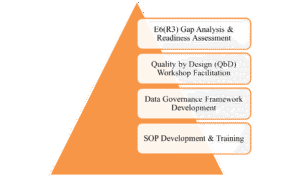
- E6(R3) Gap Analysis & Readiness Assessment: We assess your existing systems, processes, and quality culture to develop a straightforward compliance roadmap.
- Quality by Design (QbD) Workshop Facilitation: We assist cross-functional teams in recognizing essential Critical-to-Quality factors, performing risk assessments, and setting appropriate quality controls.
- Data Governance Framework Development: We assist in establishing effective data governance frameworks, focusing on computer system validation, audit trail requirements, and vendor oversight.
- SOP Development & Training: We help revise quality system documents and offer training to promote a quality culture necessary for E6(R3) success.
The ICH E6(R3) guideline marks a significant shift in clinical research, focusing on Quality by Design and enhanced Data Governance. This approach aims to improve operational efficiency, cost-effectiveness, and scientific credibility. In Ahmedabad’s clinical research sector, early adoption of these principles will be crucial for global market success.
Are your trials designed for quality from the ground up? Contact Zenovel’s Expert GCP Consultants in Ahmedabad to discuss how we can help you navigate the E6(R3) transition with confidence.