Pharmacokinetic (PK) data are crucial in clinical pharmacology and biostatistics, facing intense regulatory scrutiny. A scientifically valid but statistically inconsistent PK dataset can hinder regulatory submissions, as trust in the data is essential. Implementing a structured PK-Stat review process from study design to final data lock distinguishes a PK package that will pass regulatory review from one that leads to unnecessary information requests.
This article describes the essential components of a rigorous PK-Stat review during clinical trials, identifies common sources of inconsistencies that lead to review delays, and explains how Zenovel assists sponsors in generating regulatory-ready PK data from the initial protocol draft to submission.
PK-Stat Review ≠ End-of-Study Activity
It is a misconception that PK-statistical review is mainly a post-enrollment data-cleaning task. Key decisions affecting PK dataset quality are made earlier in the sampling schedule, bioanalytical method validation, and the statistical analysis plan. Identifying issues post-database lock is possible but cannot prevent them.
- Protocol and Sampling Schedule Design
At the design stage, the PK-stat review assesses the proposed sampling schedule’s capability to capture critical clinical and regulatory pharmacokinetic parameters, including Cmax, Tmax, AUC, half-life, and any relevant accumulation or dose-proportionality metrics. Special attention is given to sparse sampling designs for population PK modeling, as insufficient density during absorption or elimination phases cannot be rectified. A simulation-based evaluation against plausible PK models before finalizing the protocol is considered a key step in the PK-stat process.
- Statistical Analysis Plan (SAP) Alignment
The SAP must outline the PK parameter derivation methods, how to handle below-quantification-limit values, rules for missing samples, and statistical methods for bioequivalence or dose-proportionality assessments. Discrepancies between the SAP and the actual analysis are common causes of regulatory queries, as reviewers often examine the pre-specified methodology against the reported outcomes, with unexplained deviations attracting further scrutiny.
- Bioanalytical Data Review
Before deriving PK parameters, concentration data must be reconciled with the bioanalytical method’s validated performance regarding accuracy, precision, and quantification range. Documented resolution of concentration values flagged during bioanalytical QC, reintegration decisions, or assay failures is essential before their inclusion in the PK dataset, as unresolved discrepancies impact all subsequent parameter calculations.
- Noncompartmental and Population PK Analysis
This stage requires collaboration between statistical and pharmacokinetic experts. Noncompartmental analysis (NCA) must consistently handle partial AUC calculations, extrapolation percentages, and terminal-phase selection, as inconsistent terminal-phase choices are common in regulatory PK reviews. In population PK modeling, it is essential to have clear model selection criteria, thorough covariate analysis, and goodness-of-fit diagnostics that can be independently assessed by reviewers.
- Dataset Programming and Reproducibility
Regulatory reviewers are now requiring not only a summary of PK results but also a reproducible dataset and analysis pipeline. This includes CDISC-compliant PK datasets (PP and ADPC domains), thoroughly documented programming linked to the Statistical Analysis Plan (SAP), and independent statistical programming validation—usually involving a second, separately coded analysis to verify that reported parameters are accurate and not influenced by a single programmer’s decisions.
- Regulatory-Ready Packaging
The final stage involves translating validated PK results into the required tables, figures, and narrative for a Clinical Study Report and, if applicable, a Summary of Clinical Pharmacology. This ensures clear parameter definitions, consistency between PK conclusions and underlying data, and transparent disclosure and justification of any deviations from the Statistical Analysis Plan (SAP).
Common Sources of Review-Delaying and Inconsistency
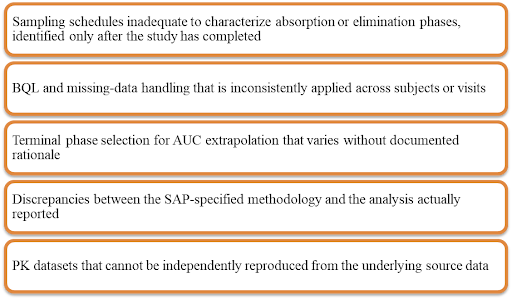
Common challenges in PK datasets for regulatory review include inadequate sampling schedules that fail to characterize absorption or elimination phases, inconsistent handling of below-quantifiable limits (BQL) and missing data across subjects or visits, undocumented rationale for varying terminal phase selection for AUC extrapolation, discrepancies between the specified methodology in the SAP and reported analyses, and the inability to reproduce PK datasets from the source data.
Zenovel supports sponsors in developing regulatory-ready PK data via an integrated review process that covers the entire study lifecycle, from protocol-stage sampling design to submission-ready packaging.
Design-stage PK review evaluates sampling schedules and SAP methodology against the study’s scientific and regulatory objectives before protocol finalization. Bioanalytical and dataset reconciliation ensures concentration data and derived parameters are consistent and traceable. It includes independent NCA and population PK support, reviewing terminal phase and model selection to address common reviewer findings. AI-driven data quality checks enhance anomaly detection in PK datasets, flagging discrepancies early. CDISC-compliant programming and independent validation support regulatory reproducibility. The output is packaged for regulatory submissions, aligning validated PK results with CSR and regulatory requirements.

Zenovel integrates PK-stat reviews throughout the development stages, alleviating the number and intensity of PK-related regulatory inquiries, thereby enhancing sponsors’ confidence in their data before submission.
For your PK stat queries, contact us at bd@zenovel.com.