Nearly seven years after its finalization by the ICH Assembly in November 2019, ICH Q12 — Technical and Regulatory Considerations for Pharmaceutical Product Lifecycle Management—has moved decisively from concept to operational reality. In 2026, the guideline transitioned from a forward-looking framework to a regulatory expectation, with the FDA adopting it in April, the EU clearing legal implementation through Regulation (EU) 2024/1701 effective January 15, and Health Canada starting its rollout. The focus for pharmaceutical companies has shifted from “if” to “how” to develop a post-approval change management strategy that utilizes the regulatory flexibility offered by ICH Q12.
This blog discusses the ICH Q12 changes in 2026, focusing on how sponsors and manufacturers often fail to fully realize its benefits. It highlights the role of regulatory and quality partners, such as Zenovel, in supporting pharmaceutical lifecycle management, from defining Established Conditions to post-approval submission.
ICH Q12 and the Post-Approval Change
Post-approval changes (PACs) in pharmaceutical manufacturing involve modifications made after marketing authorization, affecting processes or specifications. These changes necessitate numerous regulatory submissions globally, each with distinct requirements and timelines, often leading to multi-year approval processes. This complexity discourages manufacturers from pursuing continuous improvements, despite their scientific and operational validity.
ICH Q12 extends principles from ICH Q8 through Q11 to create a structured, risk-based framework for managing post-approval changes in pharmaceuticals. It aims to enhance predictability and consistency in change management across regions, aligning actions more closely with product and patient risk rather than treating each change as a separate regulatory event.
The Crucial Tools of ICH Q12
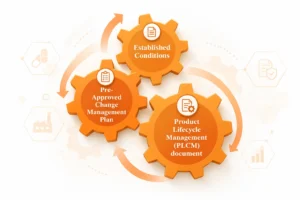
Three interconnected concepts are foundational to ICH Q12, and grasping their interactions is crucial for effective application of the guideline.
- Established Conditions (ECs) are legally binding elements of an approved application essential for ensuring product quality. ICH Q12 promotes a science- and risk-based identification of ECs, moving away from treating all dossier details as equally binding. This approach results in a more justified set of ECs, leading to fewer changes that necessitate formal regulatory notification or approval.
- A PACMP, or Pre-Approved Change Management Plan, outlines a structured approach for managing a specific future change, detailing its preparation, execution, and verification, along with associated studies and acceptance criteria. Upon agreement with a regulatory authority, the implementation of the change may require reduced reporting due to prior completion of the regulatory risk assessment.
- The Product Lifecycle Management (PLCM) document serves as a consolidated reference that evolves with a product’s commercial life, incorporating Established Conditions, reporting categories, and relevant PACMPs. Supported by the EMA’s January 2026 Q&A, it provides manufacturers and regulators with an authoritative, updated overview of established elements, potential changes with reduced regulatory burden, and aspects requiring full review.
Figure 1: Core Tools of ICH Q12
Where the 2026 Regulatory Landscape Stands
Implementation of ICH Q12 has varied by region, necessitating that sponsors of global products closely monitor regional differences instead of relying on a uniform approach.
United States: In April 2026, the FDA finalized the ICH Q12 guideline and released draft implementation guidance to clarify the submission of Established Conditions and the interpretation of ICH reporting terminology related to existing US reporting categories.
European Union / EEA: Implementation of ICH Q12 in the EU/EEA was delayed due to a 2020 finding that its risk-based EC and PLCM concepts conflicted with EU law. This obstacle was resolved through Regulation (EU) 2024/1701, with new variation guidelines coming into effect on 15 January 2026, enabling full implementation of ICH Q12 provisions.
Canada: Health Canada will begin a stepwise implementation in January 2026, initially focusing on post-approval change management protocols for biologic and radiopharmaceutical products. Broader implementation timelines will be provided as they are finalized.
Generic drug manufacturers: In 2026, discussions on generic drug manufacturers increasingly centered on the application of ICH Q12’s reporting flexibility to post-approval changes for generic drugs, highlighting the guideline’s aim to facilitate ongoing process improvements industry-wide, beyond just innovator products.
For multinational sponsors, a uniform global change strategy is currently unfeasible due to varying implementation timelines; therefore, regional regulatory intelligence is crucial during the ongoing harmonization process.
Despite increasing regulatory backing, companies often find it challenging to implement ICH Q12 effectively, leading to persistent operational flexibility issues.
- Overly broad established conditions inherited from legacy practices excessively expand the changes that necessitate formal reporting, contrary to a risk-based EC philosophy.
- Underutilization of PACMPs, especially for foreseeable changes like planned site transfers or analytical method upgrades, could significantly shorten review timelines through pre-agreed protocols.
- Regulatory and CMC documentation is fragmented, complicating the maintenance of an accurate and current Product Lifecycle Management (PLCM) document as changes occur throughout a product’s commercial life.
- Irregular regional strategies can lead to unanticipated delays when a change filed efficiently in one market conflicts with differing recognition under EC and PACMP in another.
- Weak linkage exists between quality systems and regulatory submissions, which undermines the fundamental ICH Q12 premise that a mature, ICH Q10-aligned Pharmaceutical Quality System is essential for justifying a reduced reporting burden.
Zenovel offers regulatory affairs, CMC, and quality compliance services aimed at enabling sponsors to leverage the operational flexibility intended by ICH Q12, moving away from prior conservative change management practices. Along with this, AI-powered regulatory intelligence assistance monitors the evolving implementation of ICH Q12 across various authorities, including FDA, EMA, Health Canada, and PIC/S, ensuring that sponsors do not apply outdated regional strategies.
CSV and quality system alignment is crucial for ensuring that computerized systems and PQS maturity support the reduced-reporting premise of ICH Q12 while also being prepared for inspection-level scrutiny. Additionally, global submission coordination involves sequencing post-approval change filings across various jurisdictions to adapt to the disparate pace of regional ICH Q12 implementation.
For more questions related to ICH Q12 contact us on bd@zenovel.com