
Bioequivalence study inspections focus on the trustworthiness of evidence rather than the science itself. Even with a 90% confidence interval, a BA/BE dossier may be rejected if records are untraceable, bioanalytical runs are indefensible, or the sponsor fails to demonstrate control over its vendors.
This blog examines the activities of regulatory auditors, highlighting factors that distinguish a successful inspection from those resulting in observations, data rejection, or the necessity of a repeat study.
A common misconception is to prepare for an inspection like a document review. Instead, experienced inspectors follow a subject or analytical run through its complete process —> from protocol and ethics approval to final reporting —> looking for any unexplained breaks in the chain, such as unaccounted timestamps, discrepancies between source records and the CRF, or undocumented sample movement, which then prompts further questioning.
The practical implication is that readiness involves presenting a consistent narrative across all involved systems: clinical, bioanalytical, statistical, and sponsor.
Data Integrity and Audit Trails
Data integrity is the primary focus for most inspections, with heightened scrutiny expected.
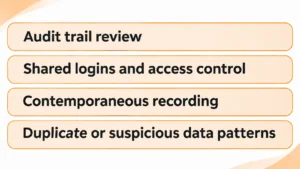
- Regulators require that audit trails for chromatography data systems, balances, freezers, and electronic CRFs be enabled, protected, and actively reviewed. Merely having a review process documented is often a significant compliance issue.
- Shared logins and access control represent significant vulnerabilities, including the use of generic user IDs, unrestricted administrator rights, and the capability to alter the system time.
- Contemporaneous recording, backdated entries, and unexplained overwriting undermine ALCOA+ principles due to their lack of original records and reliability.
- Inspectors are focusing on duplicate or suspicious data patterns, looking for statistical or documentary indicators such as identical profiles between subjects, repeated ECG or vital-sign values, and clustering of sampling times that seem implausible.
Bioanalytical Conduct in BA/BE Studies
The bioanalytical phase, critical for determining study outcomes, undergoes extensive technical scrutiny.
- Method validation
Auditors verify that the validated method is implemented and that the validation addresses conditions such as real storage stability, freeze-thaw cycles, bench-top time, and long-term storage throughout the sample holding period.
- Run acceptance and repeat analysis
Detailed inquiries will address reasons for failed runs, reanalysis of samples, and decision-makers involved. Repeats must adhere to established SOP criteria. Unexpected results leading to reanalysis, lacking pharmacokinetic or analytical justification, may be seen as testing into compliance.
- Integration practices
Manual reintegration is permissible, provided it is justified, approved, traceable, and applied consistently. Inspectors review original and reprocessed chromatograms along with the audit trail to understand any changes made.
- Incurred sample reanalysis (ISR)
Regulators mandate that ISR be executed as necessary and evaluated against set criteria, with inquiries undertaken in instances of failure.
- Sample chain of custody
Every freezer’s location, temperature changes, and transfers must be documented and reconcilable from receipt to disposal.
Clinical Site Conduct
The clinical phase is where subject protection and data authenticity meet.
- Informed consent and ethics oversight
Informed consent must be valid and version-correct, secured prior to study procedures, alongside necessary approvals from a registered ethics committee.
- Eligibility and screening
Source documents must validate that each enrolled subject fulfilled the criteria and that the screening data was not modified subsequently.
- Dosing and sampling accuracy
Actual times compared to scheduled times, along with mouth checks, fasting and posture requirements, and meal records, must be traceable and consistent.
- Deviations
Protocol deviations must be documented as they occur, evaluated for their effect on data, and addressed through recorded decisions, rather than being corrected retrospectively.
- Adverse events and safety follow-up
Adverse events and safety follow-up involve comprehensive processes for capturing, assessing, reporting, and monitoring incidents, particularly focusing on how investigators handled medical coverage during confinement.
- Investigational product accountability
Investigational product accountability involves reconciliation of test and reference products, maintaining randomization integrity, and retaining reserve samples for the required duration.
Statistics and Pharmacokinetic Analysis
Inspectors verify that the analysis adheres to the planned methodology, rather than recalculating the statistics.
- The statistical analysis plan should be finalized before unblinding, and the analysis should match it.
- Subject exclusions, outlier handling, and any deviation from the plan must be pre-specified or transparently justified.
- Software outputs, scripts, and validation evidence should be retained and reproducible.
- Reported PK parameters must be traceable back to the raw concentration data without gaps.
Sponsor and CRO Oversight
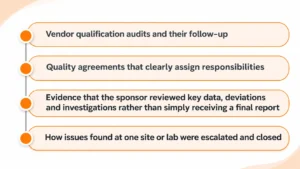
Outsourcing does not eliminate responsibility; regulators are now emphasizing the need for sponsors to demonstrate their qualifications and oversight of vendors.
Quality System Management
A site with good individual records but a weak quality system will still face challenges, as auditors seek evidence of effective quality management.
- CAPA that addresses root causes rather than restating the problem
- Trained, qualified staff with records current to the work they performed
- Equipment qualification and calibration that covers the period of the study
- Computerized system validation, backup, and disaster recovery
- Management review and an internal audit program that finds real problems
Patterns Behind Frequent Observations
Across inspection outcomes, certain themes recur:
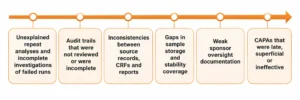
Most issues stem from routine processes that have not been tested under inspection conditions.
A Practical Readiness Approach
- Conduct a comprehensive mock audit by selecting a few subjects and tracing them through every record, simulating the procedures of an inspector from start to finish.
- Review audit trails proactively, sample critical systems, document findings, and address any unexplained issues before the regulator’s assessment.
- Investigate the effectiveness of your processes by evaluating each failed run, deviation, or out-of-specification (OOS) result to determine if an external party could trace the decision based solely on the available documentation.
- Staff should be prepared to explain their work clearly and accurately, without guessing, and it is beneficial to rehearse plans for document retrieval in both back-room and front-room settings.
- Repeat observations are considered more credible than initial findings, emphasizing the importance of closing the loop on previous results.
Zenovel provides assistance to sponsors and study sites in preparing for and responding to BA/BE audits and inspections.
- Gap assessments and mock audits across clinical, bioanalytical, and quality functions
- Review of study documentation, including protocols, reports, deviations, and investigation records
- Data integrity and audit trail review approaches
- Vendor oversight and qualification documentation
- CAPA development and effectiveness checks
- Support in drafting clear, well-reasoned responses to audit and inspection observations
The emphasis is on maintaining a study record that is robust and well-organized, rather than merely focusing on appearance for inspection day.
Regulators prioritize having defined and documented processes over perfection. Teams that practice audit readiness continuously, rather than just before inspections, tend to have fewer observations, quicker resolutions, and increased confidence in their data.
Preparing for an inspection or want an independent view of your BA/BE program? Reach out to Zenovel to discuss how we can help.