In pharmaceutical and biotech manufacturing, a facility is essential for ensuring product quality, patient safety, and regulatory compliance. Good Manufacturing Practice (GMP) establishes the standards for the production and control of medicines, biologics, and medical products, which regulators globally expect manufacturers to adhere to.
A GMP plant setup, whether new, expanded, or upgraded, is a complex process involving regulatory strategy, engineering design, validation, documentation, and personnel. This guide explains the challenges often faced and highlights how a knowledgeable partner like Zenovel can assist in overcoming these obstacles.
GMP Plant Set Up
GMP plant setup involves the comprehensive process of planning, designing, building, equipping, qualifying, and commissioning a manufacturing facility to adhere to GMP regulations. The aim is to ensure consistent production of products that meet the required quality standards. Compliance encompasses various aspects beyond production, including material and personnel flow, air handling, cleanroom classification, utilities, equipment, quality control laboratories, warehousing, waste handling, and an integrated quality management system.
Many manufacturers must upgrade their facilities to meet changing expectations, which involves assessing existing plants against current GMP standards and addressing identified gaps.

Upgrading is often more delicate than a new build, because production usually has to continue while improvements are made.
GMP varies by region, with distinct frameworks that many companies must comply with simultaneously.
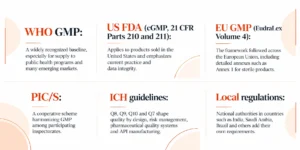
Designing with target markets in mind from the outset helps prevent costly rework later.
Key Steps for GMP Plant Setup
1. Feasibility and Concept Planning
Successful projects begin with clear definitions regarding products, volumes, target markets, and regulatory standards. This phase includes defining products and processes, planning capacity, selecting sites, estimating budgets, and establishing a realistic timeline.
2. Regulatory Strategy
Before approval of a drawing, it is essential to define the target regulatory pathways to establish design standards, documentation expectations, and inspection readiness requirements for the facility.
3. Master Planning and Layout Design
Layout design in a GMP facility is crucial as it effectively separates personnel, materials, products, and waste flows, thus preventing cross-contamination and mix-ups, while also accommodating future expansion needs. This document outlines zoning and cleanroom classification principles.
4. Detailed Engineering
This stage involves developing detailed designs for HVAC, utilities, process equipment, building services, and automation and control systems, with equipment selection focused on cleanability, material compatibility, scalability, and supplier support.
5. Construction and Installation
Constructing a GMP facility necessitates specialized finishes and controlled environments, along with meticulous coordination among civil, mechanical, electrical, and process teams. Effective quality oversight during construction mitigates the risk of expensive defects.
6. Commissioning and Qualification
Qualification shows that facilities, utilities, and equipment are properly installed and function as expected, typically following a structured sequence.
- Design Qualification (DQ): Confirms the design meets requirements.
- Installation Qualification (IQ): Verifies correct installation.
- Operational Qualification (OQ): Confirms operation within defined limits.
- Performance Qualification (PQ): Demonstrates consistent performance under real conditions.
7. Process, Cleaning and Method Validation
Once the plant is qualified, it is essential to validate manufacturing processes, cleaning procedures, and analytical methods to ensure they reliably produce the desired quality.
8. Quality System and Documentation
A GMP plant operates on comprehensive documentation, necessitating standard operating procedures, batch records, change control, deviation and CAPA management, training records, supplier qualification, and data integrity controls to be effective prior to inspection.
9. Training and Inspection Readiness
In daily practice, facility compliance is achieved through training, mock audits, and readiness assessments, which prepare teams for regulatory inspections with confidence.
General Challenges in GMP Plant Setup
- Design may not meet regulatory expectations, necessitating a redesign following inspection feedback.
- Timelines and budgets, particularly for qualification and documentation, were underestimated.
- Poor integration between engineering and quality teams results in gaps between what is built and what can be validated.
- Data integrity weaknesses in laboratory and manufacturing systems can lead to significant errors, affecting product quality and compliance with regulatory standards.
- Upgrades can disrupt production if not phased carefully, and there is limited in-house experience with international standards when entering new markets.
Most of these problems are far cheaper to prevent during planning than to fix after construction.
Core Services Offered for GMP Setup and Upgradation
A comprehensive support program typically spans the following areas:
- Gap assessment and GMP audits of existing facilities against target standards
- Feasibility studies and project planning
- Facility layout and cleanroom design support
- HVAC, utilities and equipment specification and selection guidance
- Project management across design, procurement, construction and handover
- Qualification and validation support (DQ, IQ, OQ, PQ, process, cleaning and analytical validation)
- Quality management system development and documentation
- Regulatory support and dossier readiness
- Staff training and mock inspections
- Remediation planning following inspection observations
Zenovel assists companies throughout their GMP journey, emphasizing an integrated approach that links regulatory, engineering, quality, and operational factors from the outset, rather than treating them as isolated tasks. This support spans from initial concept discussions to readiness for inspections.
- New facility setup includes guidance throughout the process, from conceptualization and layout to qualification and documentation, tailored to specific products and markets.
- Existing plant upgradation involves gap assessments, prioritized action plans, and phased implementation to minimize disruption to ongoing operations.
- Global compliance efforts are directed towards meeting the demands of regulators and frameworks pertinent to target markets.
- Quality system strengthening involves assisting in the development or enhancement of standard operating procedures (SOPs), validation documentation, change control, and corrective and preventive action (CAPA) processes.
- Inspection readiness involves conducting mock audits, providing remediation support, and training the team to ensure the site is prepared for regulatory inspections.
- Practical project-level support involves coordinating between internal teams, equipment suppliers, contractors, and consultants to ensure timelines and quality are maintained.
Manufacturers can adapt Zenovel’s support to fit their project’s scale and stage, whether they are startups establishing new facilities or established companies modernizing sites.
Check out our GMP plant setup and upgrade services for detailed information