A pharmaceutical submission typically does not fail due to weak scientific data; rather, it often encounters delays stemming from unforeseen issues. These can include last-minute changes to guidance documents, regional requirements differing from those in the submission dossier, or validation rules that reject an otherwise strong application. Such delays can extend for weeks or months, which is critical in a competitive industry where every month can result in lost exclusivity, missed launch opportunities, and wasted development resources.
This blog emphasizes the importance of regulatory intelligence in the pharmaceutical industry, characterizing it as a strategic tool rather than merely a collection of guidelines. Effective regulatory intelligence serves as an early-warning system and decision-support mechanism that ensures submission strategies remain aligned with current regulatory expectations and those anticipated by the filing date.
Where Submission Delays Really Come From
Most avoidable delays trace back to a short list of causes:
Figure 1: Reasons for submission delays
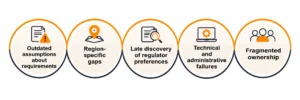
- Outdated assumptions regarding requirements have impacted the dossier, which was originally planned based on guidance that has since been revised, withdrawn, or superseded.
- In developing a package tailored to the expectations of a specific authority, there are notable region-specific gaps. These gaps manifest when the adaptation process for a different authority occurs too late, leading to discrepancies in data, formatting, or content.
- Late discoveries regarding regulator preferences can adversely affect submission teams, as expectations derived from recent approvals, advisory committee discussions, scientific advice outcomes, or deficiency letters often do not reach them in a timely manner.
- Validation errors, missing modules, incorrect metadata, and incomplete forms are identified as technical and administrative failures that result in refusal or halt procedures prior to the commencement of scientific review.
- Fragmented ownership exists within various teams such as regulatory, clinical, CMC (Chemistry, Manufacturing, and Controls), safety, and medical writing. Each team possesses a portion of the overall information, yet there is a lack of coordination, resulting in no team effectively linking changes to the comprehensive plan.
The common issue discussed is the delay or absence of vital information reaching individuals capable of taking necessary action.
Consequences of delay in project
A delay in project timelines often involves multiple factors, including refuse-to-file decisions or significant deficiencies that require extensive rework, replanning, and potentially additional studies. This situation diverts teams from other projects and can cause vendors to be re-engaged, ultimately diminishing stakeholder confidence. The commercial impact can surpass direct expenses due to competing products’ progress, highlighting that the most cost-effective delay is one avoided during the planning phase.
1. Continuous regulatory change monitoring
Regulatory change monitoring involves systematically tracking new and revised regulations across relevant regions. Its value lies in filtering updates to address three key questions: Does it impact an active program? What changes are required? By when must these changes be implemented?
2. Impact assessment
A new guideline update should focus on the assessment of how revised expectations influence the stability section of a dossier, recommending specific actions. Effective services clearly link changes to impacted products, modules, and timelines, while designating responsible individuals for these changes.
3. Region-specific interpretation of FDA and EMA submission requirements
The FDA and EMA submission requirements have many areas of overlap, but delays often stem from differences in clinical data presentation, pediatric obligations, risk management documentation, labeling formats, and procedural timelines. Understanding not only the distinct requirements of each authority but also recent application practices is crucial. Additionally, employing parallel planning for multiple regions can significantly reduce the need for rework.
4. Analyzing previous regulatory rulings
Publicly available reports and communications illustrate how reviewers address similar products and development questions. Competitive and precedent analysis aids teams in anticipating inquiries, justifying design choices, and sidestepping previously unsuccessful arguments.
5. Pre-submission readiness and compliance checks
Delays at the finish line can be minimized through a structured compliance review before filing, which ensures completeness, consistency, formatting, and technical validation of documents. Identifying mismatches between summary documents and underlying data prior to submission is more cost-effective than during review cycles.
Application of Regulatory Intelligence in Submission Process
Intelligence is most valuable when it informs regulatory submission strategies from the beginning instead of responding reactively later. Key practical steps should be incorporated from the outset.
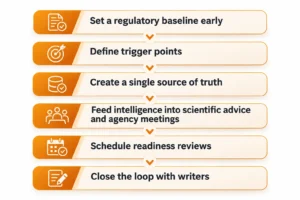
- Establish a regulatory baseline at the outset by documenting the requirements and assumptions of the development plan and target dossier, enabling later changes to be evaluated against a concrete reference.
- Trigger points are predefined changes, such as new guidance in a therapeutic area or revised electronic submission standards, that automatically initiate an impact review.
- Create a unified tracker that documents requirements, decisions, and their rationales, accessible to clinical, CMC, safety, and writing teams.
- Feed intelligence into scientific advice and agency meetings, sharpening questions for regulators using precedent and recent agency positions.
- Schedule readiness reviews by incorporating intelligence-informed checkpoints throughout the submission timeline, rather than only conducting a final check.
- Regulatory documents should align with current expectations in terms of structure, language, and justification level. Changes need to be communicated to authors before the drafting process begins, thereby closing the loop with writers.
Zenovel assists sponsors with regulatory intelligence services designed to keep submissions on schedule and on target. Our support is built around the points where delays most often begin:
Monitoring regulatory changes for products and regions, translating these into program-specific assessments, and analyzing FDA and EMA submission requirements are crucial. It involves identifying regional differences, supporting submission strategies with analyses, ensuring compliance in submissions, and aligning regulatory documentation with current standards.
Planning a submission and want to reduce the risk of delays? Contact Zenovel to discuss how regulatory intelligence can support your program.