By the time an investigator arrives, the inspection’s outcome is mostly predetermined. Observations on a Form 483 are typically not surprises for floor personnel; they reflect existing issues in the quality system. Thus, USFDA inspection preparation involves proactively identifying and addressing known weaknesses, rather than a last-minute rush.
This blog outlines the ten most common situations that lead to USFDA 483 observations, detailing what investigators look for in each scenario and how to prepare effectively for FDA inspections, whether routine surveillance or pre-approval inspections.
Why 483 Triggers Repeat
Observations consistently highlight recurring themes, stemming from shared root causes such as an overextended quality unit, idealized rather than realistic procedures, and inadequate records that fail to document events accurately. Investigators are trained to follow the data trail, treating events that cannot be reconstructed from records as though they did not occur.
As you consider the list, focus on assessing whether records can confirm adherence to procedures for each trigger, rather than merely questioning if procedures exist.
The 10 Common USFDA 483 Triggers
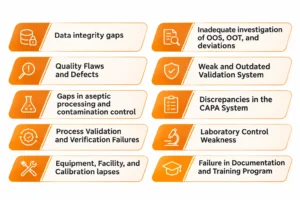
Figure 1: 483 Triggers Described by Zenovel
-
Data integrity gaps
This highest-risk area typically exhibits findings such as shared or generic logins on laboratory and manufacturing systems, disabled or unreviewed audit trails, deletion or overwriting of original data, unofficial testing (e.g., “trial” injections), and backdated or transcribed entries.
How to resolve: Routine review of audit trails is essential, not limited to audits, and should include batch and QC records. Ensure user access levels restrict analysts from modifying methods, integration settings, or system time. Retain and ensure accessibility of raw data, including chromatograms and electronic files, beyond just printouts.
-
Inadequate investigation of OOS, OOT, and deviations
Investigators often conclude with “analyst error” lacking evidence, retest until a favorable outcome is achieved, or neglect to investigate other potentially affected batches and products.
How to resolve: Ensure that each root-cause conclusion in reports is based on data, with documented reasons for disregarding any results. Assess and record impacts on other lots, and trend deviations by cause, area, and product to identify repeat events prior to investigation.
-
Quality Flaws and Defects
Observations indicate that the quality unit is approving documents without thorough review, releasing products despite unresolved issues, and lacking independence from production pressures.
How to resolve: Quality assurance should be evidenced through concrete examples such as batch rejections, supplier disqualifications, and held releases. Approval must involve a thorough review supported by documentation, rather than merely serving as a signature step.
-
Weak and Outdated Validation System
Quality assurance should be evidenced through concrete examples such as batch rejections, supplier disqualifications, and held releases. Approval must involve a thorough review supported by documentation, rather than merely serving as a signature step.
How to resolve: Reassess the cleaning validation rationale for each product family, ensuring that cleaning procedures align with operator practices and that any changes to products, equipment, or cleaning agents necessitate a documented reassessment.
-
Gaps in aseptic processing and contamination control
Investigators for sterile manufacturers evaluate various factors, including media fill design, unaddressed environmental monitoring excursions, personnel gowning and behavior in critical areas, and airflow patterns, which can be assessed through smoke studies.
How to resolve: Monitor the aseptic area during operations, ensuring visual inspections align with documented interventions. Analyze environmental monitoring trends for persistent organisms or locations and verify that each action-level excursion includes a recorded investigation with a product impact assessment.
-
Discrepancies in the CAPA System
A CAPA system full of open items, repeated recurrences of the same issue, extended due dates, or actions limited to “retrain the operator” signals an ineffective quality system.
How to resolve: Effectiveness checks should be clearly defined with measurable criteria and verified. Recurring deviations indicate a failure of the previous Corrective and Preventive Action (CAPA), necessitating its reopening. Prepare to address overdue items with a realistic plan.
-
Process Validation and Verification Failures
Findings include validation batches that do not represent routine commercial manufacturing, lack of a statistical basis for sampling plans, and no continued process verification after initial validation.
How to resolve: Process performance data should be trended and reviewed regularly. Ensure critical parameters are connected to a documented control strategy, with any changes reflected in the validation status.
-
Laboratory Control Weakness
Investigators highlight issues such as unvalidated methods, inadequate system suitability, and unstable storage conditions, along with improperly controlled reference standards and reagents, and non-adherence to written test procedures.
How to resolve: Ensure alignment between method descriptions and analyst actions, evaluate the completeness of stability protocols, escalate any out-of-trend stability results, and confirm the traceability and validity of standards, columns, and reagents within their expiry dates.
-
Equipment, Facility, and Calibration lapses
Typical observations include overdue calibration or maintenance, equipment with unresolved defects, poor facility conditions like deteriorating surfaces, gaps in pest control, and inadequate utility controls such as water and compressed air.
How to resolve: Reconcile the equipment master list with calibration and maintenance records, and inspect less-frequented areas of the facility, including ceilings, drains, and storage corners.
-
Failure in Documentation and Training Program
Batch records often contain issues such as incompleteness, uncontrolled forms, informal notes, absence of second-person verification, and operators trained on outdated procedures.
How to resolve: Audit batch records to ensure good documentation practices, focusing on contemporaneous entries, clear corrections, and complete signatures. Ensure training records are linked to current document versions and verify that individuals performing critical tasks are qualified in practice, not merely on paper.
Building USFDA Inspection Readiness
Readiness is an ongoing state that requires continuous attention, rather than a project with a defined endpoint.
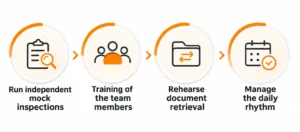
- Independent mock inspections, conducted by those unfamiliar with your facility, can identify blind spots in internal teams and evaluate your system, documentation, and personnel under pressure.
- Preparing participants in advance is crucial. Assign roles such as host, scribe, document retriever, and topic speakers. Train experts to respond honestly and concisely, and encourage them.
- Many inspections falter due to delays in finding requested records. To improve efficiency, practice retrieving a batch record, investigation file, training history, and audit trail within minutes.
- Manage daily operations by conducting a brief end-of-day debrief during inspections to review requests, verbal observations, and any commitments, ensuring all matters are resolved before the end of the day.
Figure 2: Preparing for USFDA Inspections– Zenovel
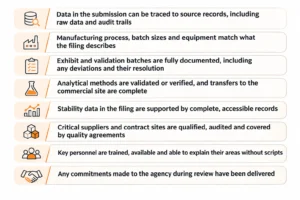
Pre-Approval Inspection Checklist
A pre-approval inspection ensures the application aligns with actual conditions, using a checklist as a foundational tool.
A Practical 90-Day GMP Pre-Inspection Readiness Strategy
Implementing a phased approach to manage GMP pre-inspection readiness is advisable when dealing with imminent notices or when aiming to be proactive.
- Days 1 to 30: Diagnose: Commission an independent gap assessment and targeted data integrity review, ranking findings by their risk to product quality and patient safety.
- Days 31 to 60: Remediate: To address high-risk gaps, prioritize reopening inadequate investigations, correcting procedures, improving system access and audit trail controls, and resolving overdue CAPAs with documented effectiveness plans.
- Days 61 to 90: Rehearse: Conduct a complete mock inspection, practice retrieving documents, finalize roles and logistics, and conduct a closing review with leadership.
Zenovel helps organizations prepare for inspections by providing technical expertise and support for regulatory compliance and documentation needs. Our services include independent GMP gap assessments, data integrity reviews in laboratories and manufacturing systems, strengthening investigations and quality documentation, pre-approval inspection preparation, inspection-room readiness, and drafting responses to FDA 483 observations, which are essential practices. Collaborating with an experienced partner enables teams to transition from reactive responses to proactive prevention of observations, fostering confidence in avoiding USFDA 483 discussions.
Planning an upcoming USFDA inspection? Contact Zenovel to discuss a readiness assessment tailored to your site and product portfolio.