A technically robust dossier may still face rejections before the review process, generally due to preventable issues. Such rejections not only incur resubmission costs but also cause lost time, delayed filings, and a team overwhelmed by last-minute corrections instead of adhering to a disciplined process. This blog provides a practical eCTD submission checklist focused on key failure points, covering eCTD compilation, publishing, and final validation.
The Real Reasons Behind Technical Rejections
Most rejections are often due to a limited number of fundamental causes rather than unusual issues.
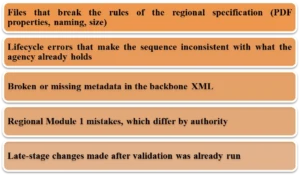
Treat each as a checkpoint in your process, not a surprise at upload.
eCTD Submission Pre-Compilation Checklist
Problems are most economical to resolve before placing any file in the sequence. It is essential to confirm this before starting eCTD compilation.
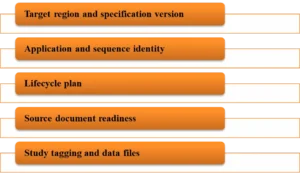
- Confirm the applicable eCTD version, regional Module 1 specification, and current validation criteria for the target region, as these can change annually.
- Verify the application number, type, submission type, and next sequence number against the agency’s records rather than relying solely on your internal tracker.
- Lifecycle planning involves determining which documents are new, which replace older versions, and which are appended or deleted. Additionally, each document should be mapped to its correct predecessor.
- Confirm that authoring teams have finalized, approved, and locked documents and that the CTD dossier format structure has been agreed with regulatory affairs.
- Ensure that study tagging and associated data files are complete and consistent with both clinical and nonclinical reports.
-
File-Level Checklist: PDFs and Naming
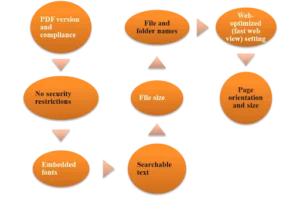
File-level defects are the primary cause of eCTD technical validation errors and can be easily automated. Check every file for accuracy.
- Ensure the PDF version is accepted by the target authority, and verify it contains no unsupported features.
- No security restrictions should be applied; remove passwords, encryption, and permissions that inhibit printing, copying, or annotation.
- All fonts must be embedded to ensure identical text rendering for reviewers.
- Searchable text requires OCR processing for scanned images, and image-only pages must be intentional.
- Maintain file size within agency limits and split large documents at logical section boundaries.
- File and folder names must adhere to specific naming conventions, including allowed characters, case sensitivity, length limits, and total path length. Names that are permissible on local drives may become invalid when the complete folder path is considered.
- Web-optimized settings (fast web view) should be confirmed as enabled where applicable.
- Check that tables, figures, and landscape pages display correctly and are not truncated by verifying page orientation and size.
-
Navigation Checklist: Bookmarks and Hyperlinks
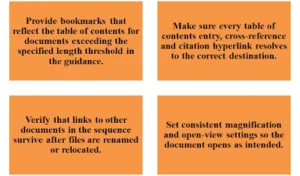
Reviewers use bookmarks and hyperlinks for navigation, and issues with navigation quality are considered a defect, even if it does not lead to outright rejection.
-
Backbone Checklist: Metadata and Lifecycle
The XML backbone is prone to subtle, often invisible failures that many authors may not notice.
- Effective leaf titles should be meaningful, consistent, and aligned with agency expectations to avoid confusion and errors stemming from duplication or vagueness.
- Lifecycle operations involve a thorough check of every new, replace, append, and delete operation. Specifically, a replace operation must target an existing leaf, and a delete operation must ensure that it does not orphan any content that is relied upon by other elements.
- Ensure that sequence numbers are accurate and properly ordered, with related sequences appropriately labeled.
- Checksums must be verified to ensure that the file checksums in the backbone align with the final files. Any modifications made to the files after publishing will render these checksums invalid.
- Confirm the integrity of the study tagging file (STF) by ensuring that each tagged study references the correct files and that the file tags are valid for their respective sections.
- Documents should be organized according to regional guidance, placing them at the expected granularity, such as individual study reports as separate leaves.
-
Module 1 Checklist: Regional Pitfalls
Modules 2 to 5 are harmonized; however, Module 1 remains unharmonized and often causes rejections for teams filing in various regions.
- Use the correct regional DTD or schema version for the target authority.
- Complete the required administrative forms and cover letter, and ensure their content matches the backbone metadata (applicant, application number, submission type).
- Match regional file naming and folder placement rules.
- Confirm any country-specific labeling, product information, or procedural documents sit in the correct subfolders.
- Check procedure type and submission type values against the pathway you are actually using.
Validation Isn’t Just Paperwork
Running a validator is essential, but alone it is not adequate. A dependable method for addressing eCTD technical validation errors involves several key steps.
- Validate early and often by running checks on interim builds to identify errors while fixes are still affordable.
- To ensure accuracy, apply the appropriate ruleset by validating against the authority’s current criteria and the specific region, avoiding generic profiles.
- Effective report triage involves addressing all errors and carefully reviewing warnings, as some may be benign, while others could highlight significant issues for reviewers.
- It is essential to re-validate after every change, as even minor edits require a fresh validation. Last-minute “quick fixes” are often a leading cause of project failures.
- Confirm lifecycle relationships by comparing against the agency’s records, particularly for later sequences, ensuring consistency with what has been received and accepted.
- Perform a human review by spot-checking the rendered sequence in a viewer, as tools cannot determine if the correct document is in the appropriate location.
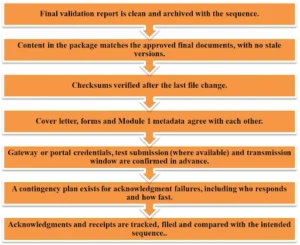
Final Pre-Transmission Checklist
Before the sequence leaves your hands:
Zenovel offers comprehensive eCTD submission services aimed at minimizing technical risks during the critical final stages. Our support includes eCTD submission and compilation tailored to the CTD dossier format as per target authority specifications. Our consultants assist with lifecycle planning and sequence management for initial filings and post-approval activities, conduct pre-submission validation, and review validation reports in a structured manner.
Additionally, the Zenovel team prepares Module 1 to meet regional requirements, ensures document formatting and remediation comply with file-level and navigation standards, and provides submission readiness reviews along with ongoing support through transmission and acknowledgment processes.
Whether you are preparing a first filing or managing a busy portfolio of sequences, having an experienced publishing partner means fewer surprises and a calmer path to eCTD submission day.
Need a second set of eyes on your next sequence? Contact Zenovel to discuss how we can support your eCTD submission.